

Solarpunk is an optimistic subgenre of science fiction that imagines a future where humanity lives in harmony with nature. These stories focus on climate-positive themes – renewable energy, sustainable cities, and community-based solutions – rather than dystopian collapse. Solarpunk novels and anthologies (including many climate fiction and eco sci-fi works) explore how ingenious technology and social cooperation can build a greener world. The following ten books (for adult and YA readers) mix classic and recent titles that feature hopeful science fiction visions: from utopian eco-villages to inspiring community revolutions. Each entry below gives the title, author, date, a short synopsis, and why it’s a noteworthy solarpunk read – emphasizing themes like sustainable futures, local communities, and positive change.
1. Ecotopia by Ernest Callenbach (1975)
Callenbach’s classic eco-utopian novel is often cited as a proto-solarpunk essential. It imagines California, Oregon and Washington having seceded from the U.S. to form an eco-friendly new nation (“Ecotopia”). In this society “everything’s clean, renewable, and locally sourced” and people are dedicated to sustainable living. The book follows a journalist touring this green society: you’ll find bicycle-powered cities, forest rewilding, and social systems built around cooperation and conservation. Ecotopia is climate-positive to its core, describing a society living lightly on the planet. It’s noteworthy as a hopeful blueprint – a “green” world “we dream about” – and it paved the way for many modern solarpunk visions.
2. Always Coming Home by Ursula K. Le Guin (1985)
Le Guin’s genre-bending novel builds a rich post-industrial culture called the Kesh in far-future Northern California. It’s presented as ethnography and mythology of a people who live in deep harmony with nature. The Kesh practice communal living, herbal medicine, song cycles, and worship natural forces. As one reviewer notes, the story “takes place in a future Brazilian [sic] city that strikes a wonderful balance between technological progress and ... ancestral cultures”. (That quote was about The Summer Prince, but Always Coming Home similarly portrays a people balanced with nature.) In Le Guin’s world, homesteads are solar- and wind-powered, and no one takes more than they need. The novel is part storytelling, part anthropology, and a bit of poetry, immersing the reader in a society that “respects both humans and the earth”. It’s a foundational work of climate fiction – almost a field guide to living lightly – and remains a key inspiration for solarpunk (emphasizing local culture, cooperation, and ecological wisdom)
3. Pacific Edge by Kim Stanley Robinson (1990)
One of Kim Stanley Robinson’s California Trilogy, Pacific Edge is a vision of an ecologically sustainable Orange County. In this alternative 1990s, humanity has solved many crises: solar and wind power are ubiquitous, cities run on permaculture, and people live in close-knit communities. The novel “focuses on community and environmental harmony, and less is more” Rather than corporate sprawl, residents grow food on reclaimed land and share resources. There is no frantic rat race – instead friends and neighbors help each other’s dreams take root. (Still, Robinson writes realistically: the plot explores the political conflicts and challenges in keeping such a utopia alive.) The book dives into the “complexities of a utopia”– how to maintain ideals, balance individual needs, and confront greed. Pacific Edge is often cited as a hopeful, climate-forward story about building an eco-friendly society in the here-and-now. It shows a sustainable future built through community cooperation and is a touchstone of solarpunk literature.
4. The Fifth Sacred Thing by Starhawk (1993)
Set in 2048, this fantasy-tinged novel depicts an ecotopian San Francisco after climate and social collapse. Here the city has become a thriving garden city: wind power and local farms feed the population, streets are dug up for community gardens and streams, and no one goes hungry or homeless. The long-lived elder council is mostly women who lead by consensus, and spiritual values run deep. The story contrasts this peaceful society with a militaristic theocracy to the south, exploring what happens when Utopian and Dystopian worlds collide. Starhawk explicitly weaves in ecofeminist and anarchistic themes, portraying a sustainable society that values equity and nature. According to summaries, “no one starves or is homeless,” and homes have gardens at every door. The Fifth Sacred Thing is climate-positive and community-driven: it’s about people protecting their commons and food supplies as an act of peace. It remains notable for its vision of shared resources, local food, and community resilience in the face of adversity (themes at the heart of solarpunk).
5. The Summer Prince by Alaya Dawn Johnson (2013)
A young-adult novel, The Summer Prince is set in a flooded-future city of Neo-Brasilia. This Afro-Amazonian society blends advanced biotech and lush nature, fusing art, ritual and technology. The heart of the story is a love triangle involving two artists, June and Enki, who use powerful digital art to challenge social norms. When a government ban on new tech threatens the city, they spark a movement. The book “strikes a wonderful balance between technological progress and Brazil’s Indigenous, Latinx, and African ancestral cultures,” making it a unique solarpunk narrative. Though it has conflict and drama, it’s fundamentally about art, community, and ecological respect. The city in The Summer Prince envisions recycling, vertical gardens, and communal projects as everyday life. (As one reviewer notes, it’s “an endearing love story” that exemplifies “the internationalist tendency in solarpunk futures”.) This novel broadens solarpunk’s scope – highlighting indigenous knowledge, queer relationships, and social justice as part of building a sustainable future.
6. Sunvault: Stories of Solarpunk and Eco-Speculation (2017) – edited by Phoebe Wagner & Brontë Christopher Wieland
This influential anthology collects short stories, poetry, and art all themed around solarpunk. It’s literally billed as “the first anthology to broadly collect solarpunk short fiction”. The pieces envision “a future of green, sustainable energy used by societies that value inclusiveness, cooperation, and personal freedom”. In practice, Sunvault contains dozens of tales from diverse writers imagining moments of change: communities at climate tipping points, activists fighting ecological disruption, or everyday people making green tech breakthroughs. The anthology emphasizes human stories in speculative settings – for example, characters harvesting bioenergy in rainforests, or urban farmers defending their rights. Because it showcases multiple voices (from sci-fi authors to poets and artists), Sunvault demonstrates the breadth of solarpunk. It’s explicitly about climate solutions and optimism: as the editors say, it focuses on people “living during tipping points … who fight to effect change”. This makes Sunvault a key hopeful-science-fiction collection – a primer on solarpunk ideals of community and sustainability.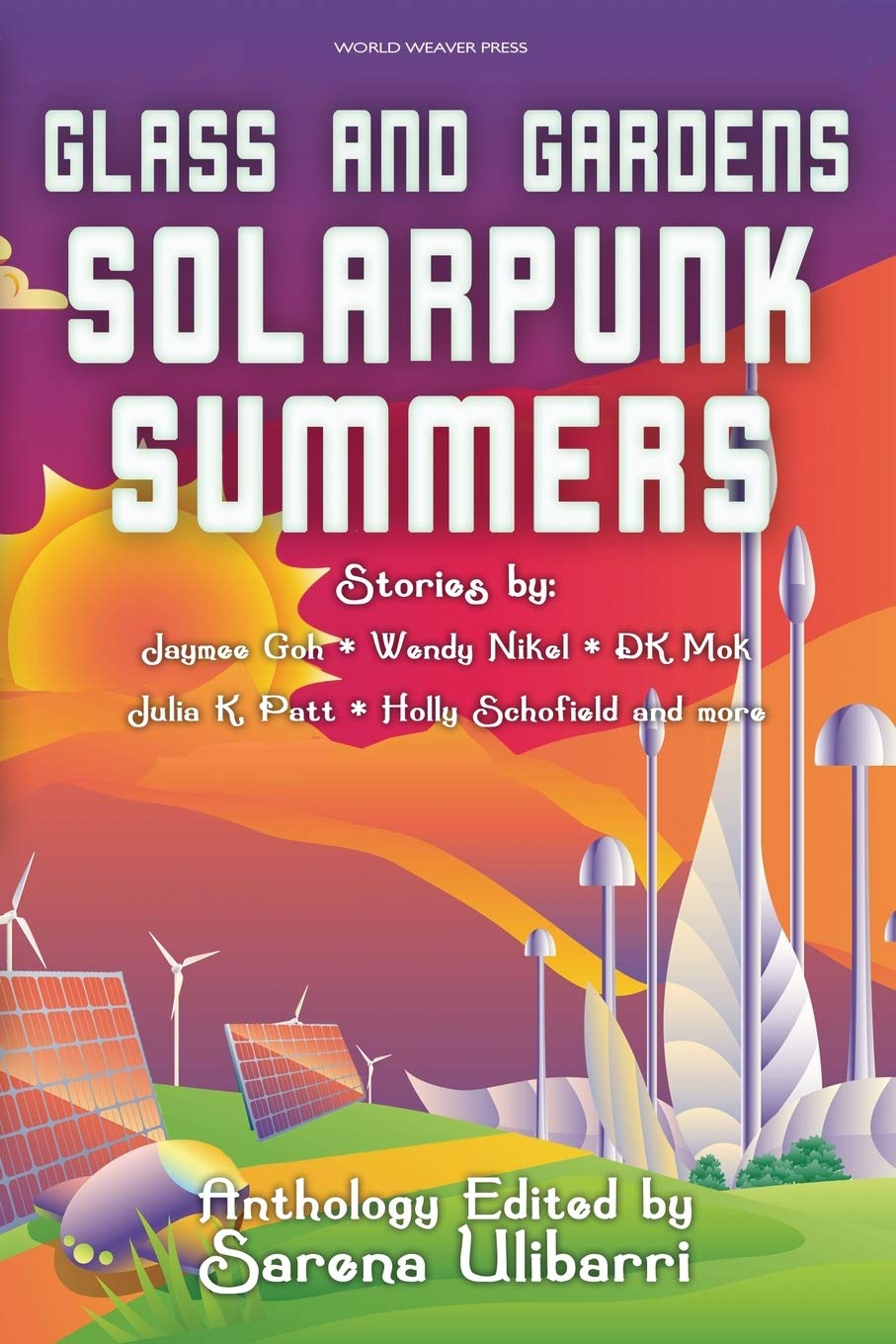
7. Glass & Gardens: Solarpunk Summers (2021) – edited by Sarena Ulibarri
(Solarpunk Winters, 2022)
The Glass & Gardens series comprises two themed anthologies (Solarpunk Summers and Winters) that explore sustainable futures seasonally. In Solarpunk Summers, stories focus on spring/summer environments: gardens, food, technology in warm climates. The follow-up Solarpunk Winters imagines similar utopian societies surviving harsh seasons. As one reviewer explains, “Solarpunk Summers contains stories with themes ranging from the relationship between technology and nature, to creativity and adaptation, food ethics, and more.” Meanwhile “Solarpunk Winters… explores what future solarpunk societies might be like during the winter season.” Collectively, they’re rich in community-building tales: small towns innovating to feed everyone, neighbors cooperating through crises, “normal people who rise above extreme and extraordinary situations”. Both books celebrate “survival” through solidarity and imagine “small utopias within the ashes of destruction”. The series is important for its diversity of hopeful visions – featuring climate solutions, eco-tech, and multicultural casts – and is often cited alongside Sunvault as a core introduction to solarpunk fiction.
8. The Ministry for the Future by Kim Stanley Robinson (2020)
A near-future climate thriller that is unabashedly hopeful. The novel is framed around a UN agency (the titular “Ministry”) created to protect future generations from climate change. Across global vignettes – from African drought camps to Swiss boardrooms – it shows how humanity might combat climate catastrophe. As one summary notes, it portrays “a future where a global organization is set up to save the planet, using everything from financial incentives to geoengineering”. The characters include scientists, activists, and policymakers all working on solutions. Though intense (it doesn’t shy from disasters), the book “is packed with real-world solutions that could actually make a difference”. Robinson’s storytelling is granular and optimistic: for example, sequences describe cities adapting to heat, rewilding efforts, and even citizen-led crypto-power. It won praise as a “thought-provoking and meticulously researched exploration of climate change”. In solarpunk terms, The Ministry for the Future is noteworthy for blending hard science with real hope – advocating collaborative action and showing how communities worldwide can innovate for a sustainable future.
9. New York 2140 by Kim Stanley Robinson (2017)
Robinson’s climate saga set in a flooded NYC is a cornerstone of modern solarpunk fiction. The title picture is literal: “New York City, but make it Venice.” Over half of Manhattan is under water, and the story follows a large cast of characters adapting to this world. People live in vertical skyscrapers and travel by boats on flooded streets, but everyday life continues. The novel emphasizes how residents cooperate to survive: raising crops on rooftops, sharing boats, installing flood defenses. One reviewer describes it as “epic and surprisingly hopeful” – “showing that even with disaster, humans find a way”. Its key solarpunk element is community resilience: New Yorkers work together, pooling resources and creativity to rebuild society under new sea-level realities. Robinson uses sharp social commentary (income inequality in the skyline versus the drowned streets) but ultimately highlights collaboration. As one analysis puts it, New York 2140 is “about communities working together… to adapt to climate change and overcome adversity”, embodying exactly the optimistic spirit of solarpunk This novel earned acclaim for depicting a radically changed world where human ingenuity (and communal effort) lightens the climate burden.
10. A Psalm for the Wild-Built by Becky Chambers (2021)
Chambers’ novella (and its sequel A Prayer for the Crown-Shy 2022) offers a cozy, gentle vision of a solarpunk future. The series is set in a world where people have nearly eliminated want: work has been automated, money is gone, and communities prioritize wellbeing. The heroine is Dex, a tea-brewing monk seeking purpose, who befriends Mosscap, a friendly robot exploring what humans need. Unlike gritty dystopias, these books are “like a warm hug,” combining “philosophical depth with charming world-building” In this society, “people have what they need, tech is eco-friendly, and there’s zero hustle culture” For example, houses are sustainably designed, children learn by gardening, and travel is by solar-powered train. The narrative focuses on small questions of contentment and purpose, but it underscores solarpunk ideals: living lightly, fostering community, and respecting nature. Reviewers praise the introspection and hope: they call it “thoughtful, uplifting”, blending quiet adventure with big ideas. A Psalm for the Wild-Built stands out as “optimistic solarpunk” (even designated Hopepunk) – a reminder that a gentle, sustainable future can be just as exciting as any space adventure.
Conclusion: These ten solarpunk books paint varied yet all inspiring pictures of greener futures. They share themes of renewable energy, community solidarity, and imaginative climate solutions. Whether through utopian societies (Ecotopia, The Fifth Sacred Thing), intimate community stories (Always Coming Home, Psalm for the Wild-Built), or big-picture climate action (Ministry for the Future, New York 2140), each novel asks: “What if we built a better world?” Their characters often form new communities, revive nature, and prove that humans can adapt with kindness and creativity. In exploring these hopeful science fiction and eco-sci-fi tales, readers will find climate fiction that uplifts rather than terrifies – offering “visions of a future where humanity and the planet work hand in hand” We encourage you to dive into these imaginative solarpunk stories and be inspired to help create sustainable, fairer communities today. Happy (hopeful) reading!