

Solarpunk is a creative movement and aesthetic imagining a bright sustainable future driven by renewable energy, environmental balance, and community cooperation. In gaming, solarpunk video games center on eco-friendly themes – building with green tech, healing ecosystems, and collaborative societies. These titles, from major releases to indie gems, appeal to players interested in green gaming, games about sustainability, and environmental games. They often emphasize renewable energy, local communities, and a hopeful vision of the future Below is a summary of standout solarpunk games our team loves.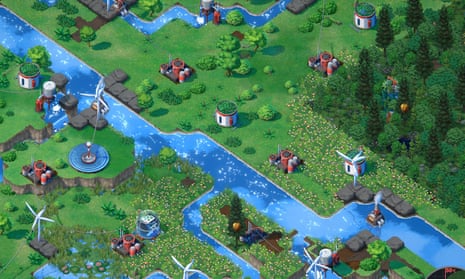
Terra Nil (March 2023, Free Lives)
Terra Nil is a “reverse city-builder” where players must rehabilitate a barren wasteland back into a thriving ecosystem rather than exploit it. Developed by Free Lives and released March 28, 2023, the game embodies solarpunk by focusing on ecological restoration. Players unlock and deploy green tech – purifiers, planters, recirculators – to clean soil, refill oceans, plant forests, and reintroduce wildlife. Gameplay features include single-resource management and tech-tree progression; each level challenges you to fully “leave without a trace”, removing all structures after restoring nature. As Kotaku notes, Terra Nil was inspired by the rewilding movement and “seeks to restore nature rather than exploit it” making it a quintessential eco-friendly game.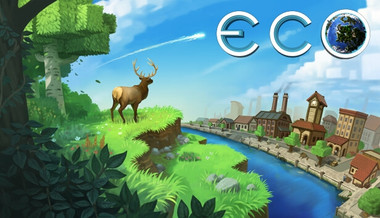
Eco (Feb 2018, Strange Loop Games)
Eco is a multiplayer survival/simulation game where a community must advance technology and protect the ecosystem simultaneously. Released in early access February 2018, Eco’s premise is that players on a virtual planet must stop an incoming meteor by building a civilization without destroying the environment. Developers describe it as a fully simulated world where “every action affects the world” – chop too many trees and air purity drops, over-fish and species die out. Notably, Eco requires players to form governments, create laws, and share data to regulate resource use. In-game features include farming and infrastructure development balanced by pollution management, taxation/grant systems, and global data analysis. By design, there are no combat or monsters – it’s about cooperation and sustainability, aligning with the solarpunk ideal of community-driven, eco-conscious living.
Imagine Earth (May 2021, Serious Bros.)
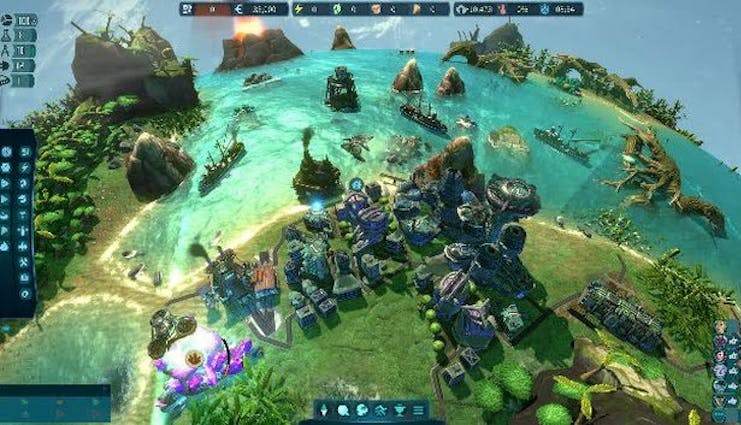
Imagine Earth is a colorful climate-simulation game of interplanetary city-building. In this global strategy sim, you manage colonies on distant planets and must balance economic growth with environmental health. Developed by Serious Brothers and released May 25, 2021, players research renewable tech and sustainable industry to reduce emissions and avert climate disasters. As the developers put it, “Imagine Earth focuses on the conflict between economic growth and environmental destruction… establishing a balance between growth and sustainability”. Key features include real-time climate modeling (burning fuel raises sea levels and triggers disasters), planetary trade, and multiple difficulty modes. The Steam banner image (above) shows the lush planets you’ll cultivate; gameplay emphasizes that every factory and power plant choice can tip the global climate one way or another. Imagine Earth’s combination of city-building and climate crisis underscores solarpunk themes of responsible tech and global ecology.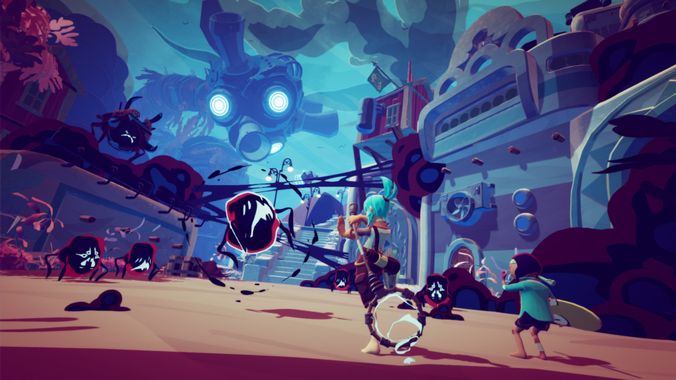
Wavetale (Dec 2022, Thunderful Games)
Wavetale is a short action-adventure set in a sunken archipelago. Players control Sigrid, a young girl who befriends a mystical shadow, giving her the ability to walk on water and traverse between buildings over the sea. Developed by Thunderful Games and released Dec 12, 2022, the game features bright, island-themed environments. Although Wavetale is story-driven and combat-light, its setting of reclaimed waterways and island communities speaks to solarpunk ideas of humans adapting harmoniously to changed environments. Notable gameplay features include speedboat-like movement on water, swinging across rooftops with a net, and solving light puzzles to rescue villagers from “sea monsters”. While Wavetale’s focus is on narrative and mood, it subtly promotes community cooperation in facing the challenge of a submerged world– fitting into a green-gaming aesthetic of rebuilding after ecological upheaval.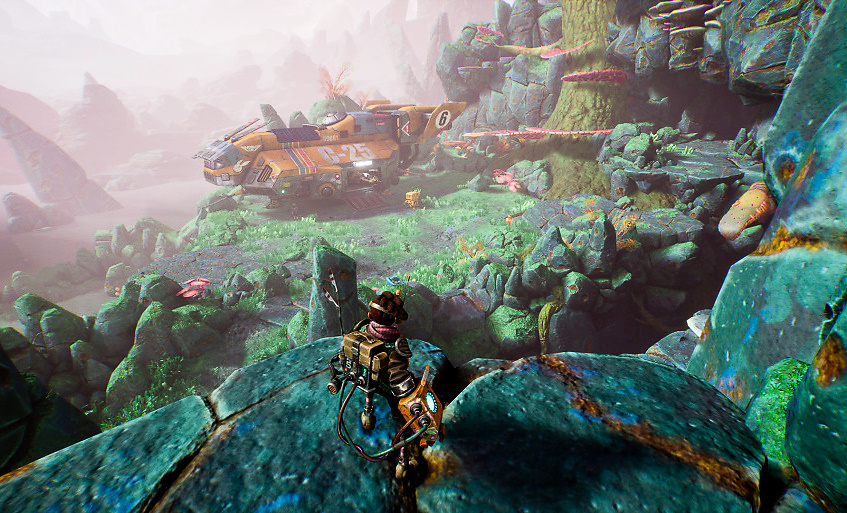
The Gunk (Dec 2021, Thunderful Development)
In The Gunk, players explore a lush alien planet marred by a spreading black parasite. Developed by Thunderful (Image & Form) and released Dec 16, 2021 the game stars space scavengers Rani and Becks. The world’s biomes are rich with life – until they’re covered by the “gunk,” a toxic goo harming the environment. Using a vacuum-like power-glove, Rani sucks up the gunk to instantly restore each area. Gameplay involves platforming, exploration, and resource collection, but the core loop is environmental cleanup: vacuum pollution, watch plants and animals flourish again, and scan newly revived wildlife. The Wikipedia description highlights this cycle: “a strange organic substance…has polluted the environment, but removing the gunk…helps to restore the beauty of the planet”. Thus The Gunk is literally about using technology to heal a damaged ecosystem, a direct solarpunk metaphor.
Beyond Blue (June 2020, E-Line Media)
Beyond Blue is a single-player underwater exploration game inspired by natural history documentaries. Released June 11, 2020 it casts you as Mirai, a deep-sea scientist using futuristic tech (including a submarine and drones) to research and protect marine life. The official site describes it as exploring our ocean’s mysteries in the near future, joining a research team to see, hear, and interact with the ocean in a more meaningful way. Beyond Blue’s gameplay is narrative-driven rather than challenging, but its themes are solidly solarpunk: players help rehabilitate habitats after a storm and learn about ocean ecosystems. Notable features include realistic whale and shark interactions, data-collection mini-games, and a calm, educational tone. As Steam notes, Beyond Blue takes you “deep into our planet’s beating blue heart”, emphasizing ocean conservation and wonder — an ideal fit for eco-friendly gaming.
Planet of Lana (May 2023, Wishfully)
Planet of Lana is a lush 2D puzzle-platformer with a hand-drawn art style. Released May 23, 2023, it follows Lana, a girl journeying across a verdant world now threatened by a faceless army of machines. The developer Thunderful describes the story as “about a vibrant, beautiful planet – and the journey to keep it that way”. Gameplay blends stealth, puzzles, and cooperative AI (Lana’s pet animal Loki assists her). The game’s solarpunk element lies in its visuals and story: technology in Planet of Lana is initially benign, powering cities in harmony with nature, but corruption has unbalanced the ecosystem. Themes of ecological harmony and resistance to destructive tech pervade the narrative. For example, one section requires navigating a forest without harming it. Planet of Lana doesn’t explicitly preach green energy, but its very premise – humans and nature once in balance, now fighting to restore it – resonates strongly with solarpunk ideals of ecological balance.
Star Wars: Episode I – The Gungan Frontier (May 1999, Lucas Learning)
This classic PC game from 1999 is a science-education title with a solarpunk twist. It’s a life-simulation strategy game where you help the Gungans build a bubble city by creating a stable ecosystem on a moon of Naboo. In game terms, players introduce plants and animals to Ohma-D’un to “develop a stable ecosystem capable of supporting Gungan colonization” In effect, it teaches food webs, population dynamics and ecological balance. Though tied to Star Wars lore, its core is “carefully balance an alien eco-system”. There’s no fighting – just arranging species, planting crops, and watching how changes ripple through the environment. Gungan Frontier is explicitly about environmental stewardship in a sci-fi setting, making it an early example of a solar-age, eco-focused game (albeit designed for kids). It emphasizes environmental management over conflict, fitting well with the list of games about sustainability.
Abzû (Aug 2016, Giant Squid)
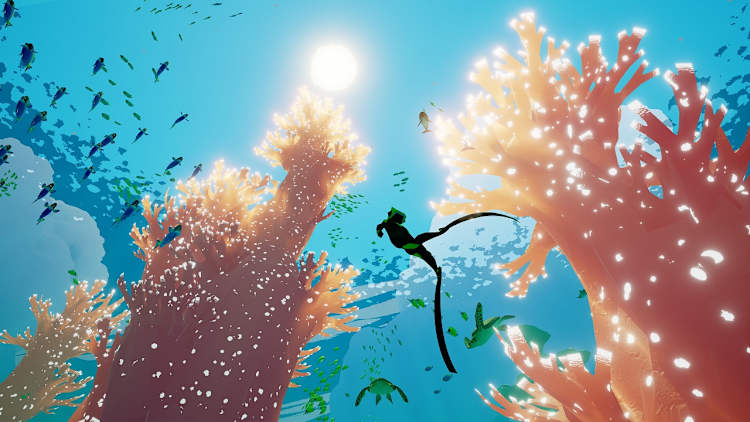
Abzû is a dreamy underwater adventure from the creators of Journey. Released Aug 2, 2016, it has players diving through vast oceans filled with fish, manta rays, turtles, and other marine life. The word “abzu” comes from Sumerian mythology meaning “ocean of wisdom.” The developer describes the gameplay as “following the journey of a diver exploring the ocean and restoring life using sonar calls” In practice, you swim freely, triggering schools of fish and coral growth with your sonar pulse. The atmosphere is meditative: the music swells as lost seas are rejuvenated. Although Abzû has no explicit tutorial, its story (told without words) is about activating hidden wells of energy to bring life back to the seas. With its focus on recovery of a ruined environment and no combat, Abzû offers an immersive ecological experience consistent with solarpunk’s reverence for nature.
My Time at Portia (Jan 2019, Pathea Games)
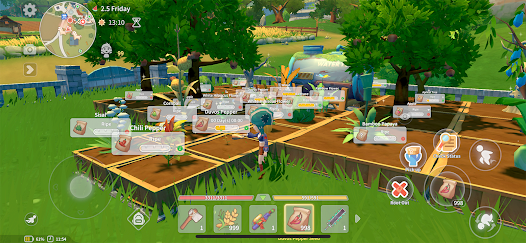
My Time at Portia is a popular farming/crafting RPG set in a post-apocalyptic world. It debuted January 15, 2019 on PC (with console and mobile ports following). You play as the child of a master builder, arriving in the town of Portia to inherit and run a workshop. The setting is a sunny, rebuilt society where humanity is underground but now emerging to rebuild cities using salvaged and new technology. Gameplay combines farming, crafting, questing and town-building, much like Stardew Valley but with 3D graphics and story-driven missions. The game encourages sustainable development: you grow crops, raise animals, and upgrade machinery to build eco-friendly structures (e.g. a bio-fuel maker instead of oil). The lore emphasizes cooperation – rival builders exist, but the ultimate goal is to create a better town together. My Time at Portia’s cheerful vibe and emphasis on community restoration make it akin to green gaming: though not explicitly labeled solarpunk, it embodies sustainable community-building and DIY ingenuity.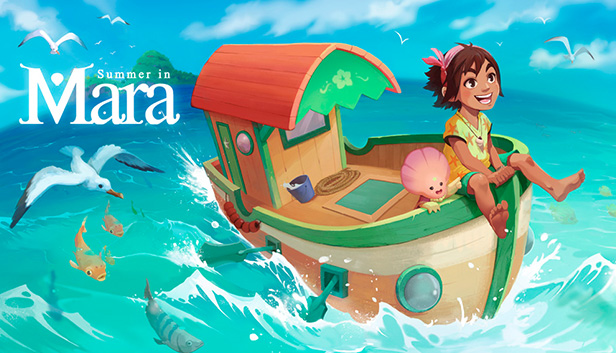
Summer in Mara (June 2020, Chibig)
Summer in Mara is a relaxed farming and exploration sim on a tropical archipelago. Released June 16, 2020, you control Koa, a young girl whose island paradise is threatened by ecological imbalance. The game’s key loop is caring for your own island – planting trees, harvesting crops, and raising animals – while sailing to new islands on the open ocean. It emphasizes caring for nature in a Caribbean-inspired world: for example, you can plant mangroves to protect coasts or create coral gardens. As the developer says, you’ll “take care of your island, harvest your crops, create new tools and buildings, and sail… to discover new islands and secrets”. Notable features include a day-night cycle with weather effects, and over 20 characters who each work on the broader welfare of the archipelago. Summer in Mara’s aesthetic and gameplay – harvesting, building, trade, and helping villagers – resonate with solarpunk values of community resilience and ecological harmony, wrapped in a charming, eco-friendly package.
Europa (Oct 2024, Future Friends Games)
Europa is a 3D adventure/platformer released Oct 11, 2024. In it, you play as Zee, an android child exploring the remnants of a terraformed paradise on Jupiter’s moon Europa. The world is lush and green, the product of advanced technology rebuilding environments. The Steam page describes it: “On the moon Europa, a lush terraformed paradise in Jupiter’s shadow… an android named Zee sets out in search of answers”. Gameplay is all about high-speed traversal – run, glide, and fly – across a bright, colorful landscape, solving platforming puzzles. The story unfolds through environmental storytelling: you uncover ruins of a lost human colony and learn how they created a sustainable ecosystem on this moon. Europa’s core theme – rediscovering how advanced society lived in balance with nature on a new world – fits perfectly with solarpunk imagery of high tech regenerating wild places.
Each of these games approaches the solarpunk vision in its own way – whether by letting players restore ecosystems (Terra Nil, The Gunk), manage climate and resources (Eco, Imagine Earth), or simply experience vibrant natural worlds (Abzû, Beyond Blue, Planet of Lana). Together, they showcase a trend toward eco-conscious game design and green gaming, blending fun with optimism about sustainable futures